Thermal Analysis
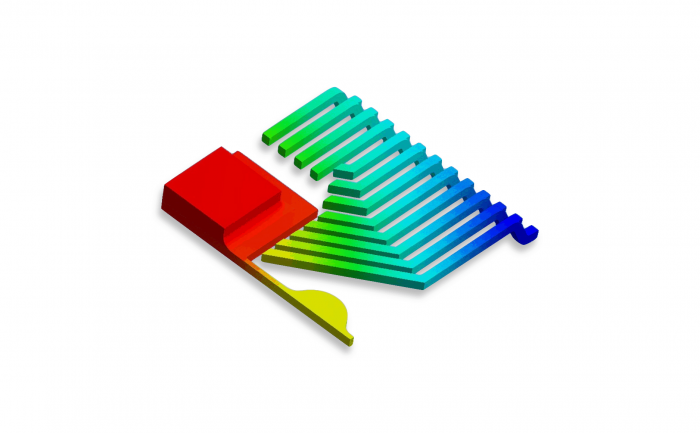
Thermal analysis is used to predict temperature distributions and heat flows within structures subjected to a thermal loading. Structural stresses resulting from thermal loading can be predicted when thermal results are coupled with a structural analysis. Residual stresses left behind in the structure after the thermal load has been removed can be quantified and are important for predicting fatigue life. In order to predict how fluid or air flow around a part influences its cooling, computational fluid dynamics (CFD), can be used to charaterise the flow and predict heat transfer rates. Applications for thermal analysis typically include heat exchangers, heat sinks, and electronic components.
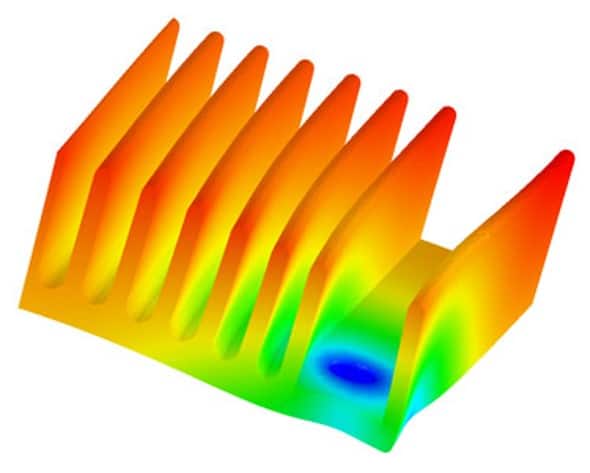 Thermal analyses have become increasingly important as designers push for higher performance machines. This means that a good understanding of temperature distribution and thermal loads can often be vital. An incorrect constraint in a system working under elevated temperature can lead to unexpected high thermal stress which may lead to failure. Thermal analysis can be performed using FEA or CFD. FEA method is often preferred when evaluating thermal stress is the main purpose of the analysis or the boundary conditions are well defined. CFD is a better method in estimating flow boundary conditions (heat transfer coefficient and fluid temperature) when the flow or structure geometry is complex. Fluid-Structure Interaction (FSI) can be used for flow simulation first to give accurate thermal boundary condition then followed with stress analysis. FSI will be more demanding on computing resources.
Steady state thermal analysis can be used to determine the temperature distributions in an object with thermal loads that do not vary with time. The heat transfer in steady state thermal analysis includes conduction, convection and radiation. Most thermal analyses are steady state thermal analyses.
Transient thermal analysis is time dependent. Transient Thermal analysis can be used to evaluate the cooling process of a system or a thermal induced stress due to a sudden temperature change.