 051 845648
 info@seam.ie

Case Study Overview
Project partners:
Student: Ian Kavanagh (AMASE Programme)
Collaborators: SEAM (Bruno Zluhan) and 3DWIT (Carlos Pando)
Programme credit: AMASE (David Alarco)
Summary (at a glance)
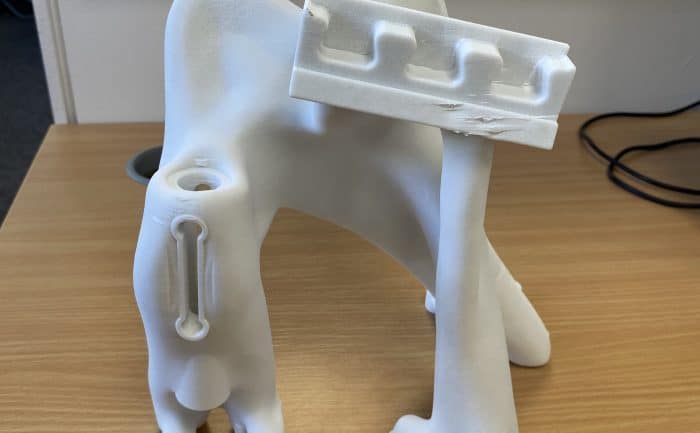
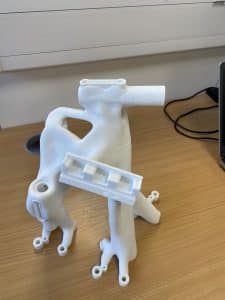
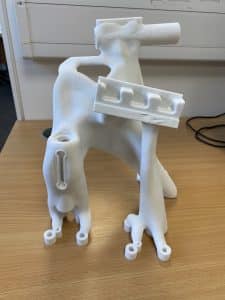
- Objective: Design a lightweight fixture and assess compliant mechanisms for clamping
- Approach: Generative design + Design for Additive Manufacturing (DfAM) + rapid prototyping
- Tech used: SLS 3D printing (EOS Formiga P110), PA2200 Nylon, FDM prototypes, CMM checks, Instron ElectroPuls E3000
- Result: Promising strength/accuracy with 0.05 mm deviation vs. traditional fixture; >40,000 load cycles on the compliant clamp (FDM prototypes)
- Outcome: A validated path toward a lighter, more efficient fixture using additive manufacturing (AM)
The Collaboration
This case study showcases how SEAM and 3DWIT support the AMASE programme by combining academic insight with industrial-grade facilities. Ian Kavanagh was able to access state-of-the-art additive manufacturing equipment at both 3DWIT and SEAM, turning a research concept into functional prototypes—fast. The partnership exemplifies how AM is positively changing the way companies ideate, prototype, test and iterate new tooling and fixtures in Ireland.
The Challenge
The goal was to reduce fixture weight without sacrificing strength or positional accuracy. That’s harder than it sounds: removing material is easy—keeping durability and repeatability under cyclic loading is not. Each iteration needed careful thought about where material is truly needed, and where generative design could safely remove it.
Approach & Methodology
- Generative Design & DfAM:
CAD concepts were iterated with generative design to explore lighter geometries that still met stiffness and clamping needs. DfAM principles ensured parts remained printable and functional. - Rapid Prototyping & Test:
Early prototypes were FDM-printed to validate the compliant mechanism. The clamp endured 40,000+ load cycles on an Instron ElectroPuls E3000. CMM checks confirmed a deviation of only 0.05 mm versus the traditional fixture. - Material & Process Selection (SLS):
For functional evaluation, parts were produced in PA2200 Nylon using an EOS Formiga P110 SLS system—chosen for its mechanical properties, accuracy and surface finish suitable for functional fixtures.
Why Additive Manufacturing?
Additive manufacturing (AM) is transforming how teams concept, prototype and validate. Instead of waiting weeks for machined parts, engineers can move from CAD to functional SLS parts in days, collecting real test data to refine designs quickly.
Benefits for industry:
- Faster iteration: Collapse design–build–test cycles from weeks to days
- Weight reduction: Complex lattices/topology-optimised forms not feasible with machining
- Fit-for-purpose strength: Targeted stiffness where it matters; compliant features where useful
- Lower risk: Validate function and ergonomics before committing to tooling.
Equipment & Materials
- SLS 3D Printing: EOS Formiga P110
- Material: PA2200 Nylon—balanced strength, accuracy and repeatability for fixtures
- Mechanical Testing: Instron ElectroPuls E3000 for cyclic loading
- Metrology: CMM checks for dimensional accuracy
Results
- Accuracy: 0.05 mm deviation vs. the traditional fixture (from FDM prototypes; SLS expected to improve further)
- Durability: Compliant mechanism clamp survived >40,000 load cycles
- Design insight: Generative parameters tuned to balance lightweighting and rigidity
Learnings & Next Steps
- Move to SLS: Validate the PA2200 Nylon SLS parts under real duty cycles
- Extended durability: Broaden fatigue testing and polymer creep analysis
- Materials roadmap: Investigate reinforced/composite materials for higher stiffness/strength
- Integration: Aim for full fixture integration with validated performance
A Model for Research–Industry Impact
This project demonstrates the value of collaboration between education, applied research and industry. By leveraging SEAM and 3DWIT capabilities, AMASE participants progress from hypothesis to defensible, production-relevant data—the kind of evidence companies need to de-risk decisions.
Acknowledgements:
AMASE – David Alarco · 3DWIT – Carlos Pando · SEAM – Bruno Zulhan