
Problem to be Solved
Uncertainty regarding device performance and structural integrity under physiological pulsatile blood flow conditions during early-stage development.
Customer Question:
How will the device behave during the haemodynamic cycle, and what is the impact of cyclic loading on long-term structural integrity and fatigue life?
Solution:
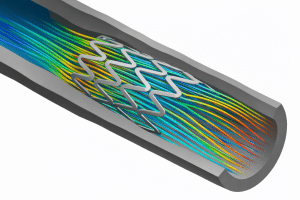
Investigate haemodynamic behaviour using CFD modelling of representative pulsatile arterial flow conditions and determine structural response and fatigue risk via coupled FEA analysis using a Fluid Structure Interaction (FSI) framework.
SEAM Answer:
SEAM offers advanced CFD and FEA expertise to support cardiovascular device development through predictive in silico modelling aligned with recognised regulatory and verification frameworks. SEAM can develop transient CFD models of pulsatile blood flow within idealised or patient-specific arterial geometries incorporating the medical device under investigation, consistent with ASME V&V 40 credibility principles for computational modelling. These models can capture time-resolved pressure fields, wall shear stress distribution, and potential flow recirculation regions throughout the cardiac cycle, supporting haemodynamic performance evaluation in line with relevant cardiovascular standards such as ISO 25539 and ISO 5840 where applicable.
The resulting transient pressure and shear loads can then be mapped onto a structural FEA model of the device to calculate deformation and stress response under cyclic haemodynamic loading, using a coupled Fluid Structure Interaction (FSI) methodology. Structural integrity, fatigue life, and risk-informed assessments can be performed in alignment with ISO 14971 risk management processes, enabling traceable documentation suitable for regulatory submissions under EU MDR and UK regulatory pathways. This integrated workflow enables identification of peak stress regions, evaluation of fatigue-sensitive zones, derivation of structural integrity margins, and generation of defensible in silico evidence prior to physical testing.
Customer Outcomes:
Through this modelling approach, customers can optimise device geometry at an early stage, minimise adverse haemodynamic effects, and reduce stress concentrations before prototype manufacture. Quantification of cyclic stress amplitudes and fatigue margins can support material selection, structured risk assessment, and regulatory submissions with robust, V&V-informed in silico evidence, while reducing the number of physical prototype iterations and accelerating time-to-market in a highly regulated MedTech environment
About the Author
Arun Antony is a Chartered Engineering Leader with over a decade of experience in engineering and R&D, specialising in CFD and FEA simulation. At SEAM, he works on advanced CFD and structural analysis projects supporting engineering design, integrity assessment, and innovation. He has also led R&D programmes, digital transformation initiatives, and cross-functional teams delivering complex engineering solutions. As an Executive MBA candidate, he combines deep technical expertise with strong strategic and business insight.
Contact Arun at Arun.antony@setu.ie for further information about SEAM’s CFD and FEA capabilities .