
Client Challenge – Understanding Corrosion in Threaded Rebar
The client submitted threaded reinforcement bars that showed visible surface corrosion, raising concerns regarding:
-
Potential penetration depth of corrosion
-
Breakdown of zinc protective coating
-
Possible loss of mechanical integrity
-
Suitability of the bars for continued service
The objective was to determine whether the corrosion posed a structural risk and whether the bar still met performance requirements and to identify corrosive by products and the possible source.
SEAM Testing Methodology
SEAM performed a structured assessment using industrial-grade laboratory technology:
- Sample preparation: cutting, mounting, grinding, polishing
- SEM-EDX microstructural and surface chemistry analysis
- Rockwell hardness testing
- Optical Emission Spectroscopy (OES) for material composition
- Instron 8800 tensile testing for mechanical strength
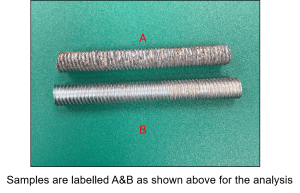
1) Sample Preparation
Sections were cut, mounted in epoxy, ground and polished for controlled analysis.
2) Scanning Electron Microscopy (SEM) & EDX Surface Analysis
SEAM utilised its advanced Scanning Electron Microscope (SEM) equipped with Energy Dispersive X-ray Spectroscopy (EDX) to:
-
Analyse coating condition & thickness
-
Examine microstructure & corrosion products
-
Identify salt-induced corrosion elements
-
Map surface elemental distribution
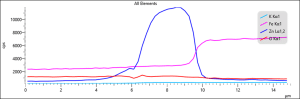
An EDX line scan starting from the surrounding resin and crossing into the sample confirms the presence of the Zinc (Zn) coating which appears to be approximately 5µm in thickness. Line scans were utilized to examine coating integrity .
This analytical technique is ideal for corrosion failure analysis, coating evaluation, and microstructural investigation.
3) Hardness Testing
Hardness testing was performed using the ZwickRoell Indentec Hardness Tester to evaluate the material’s resistance to deformation. The process involved applying a controlled load via an indenter and measuring the resulting impression. Results provided accurate, repeatable data essential for assessing material strength, quality control, and confirming heat treatment effectiveness. Mounted samples underwent Rockwell hardness testing to detect any loss of surface strength.
This confirmed material uniformity and resistance to mechanical wear.
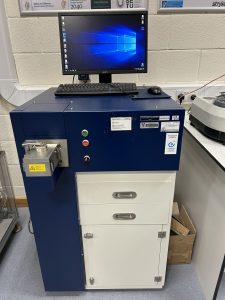
4) Optical Emission Spectroscopy (OES)
Optical Emission Spectroscopy (OES) is a widely used analytical technique for determining the elemental composition of metal alloys. It works by exciting atoms in a sample to emit light at characteristic wavelengths, which are then measured to identify and quantify the elements present. OES allows accurate alloy identification and rapid grade confirmation, critical for steel compliance and QA.
5) Tensile Testing on Instron 8800 Series System
The remaining bar length was tensile tested on SEAM’s Instron 8800 servo-hydraulic testing system, capturing:
-
Yield and ultimate tensile load
-
Load-displacement behaviour
-
Failure characteristics

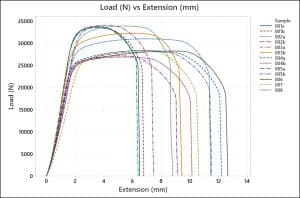
The ultimate tensile load for all samples averaged 30.7kN, with a standard deviation of 2.9kN. Assuming threaded bar is supplied per ISO 898-1. All samples meet the requirement of property class 4.8 with a minimum ultimate tensile strength of 24.4kN
The Instron 8800 series provides high-precision mechanical testing for industrial QA and R&D.
SEAM can support your inspection needs at every scale — from the micrometre level right up to large industrial components. Get in touch to discuss your project. For corrosion or structural materials testing contact SEAM’s Materials characterization team here