 051 845648
 info@seam.ie

Case Study Overview
The Challenge: Excessive Tank Vibration During Operation
A leading chemical process facility experienced persistent tank vibration during live operation, raising concerns around structural fatigue, shock loading, and long-term vessel integrity.
Although the tank remained operational, the client needed clarity on two critical questions:
-
What is the root cause of the tank vibration?
-
Is the vibration compromising structural integrity or reducing remaining service life?
Understanding whether the issue stemmed from fluid dynamics, process instability, or structural response was essential before implementing corrective measures.
SEAM’s Engineering Approach
SEAM conducted a comprehensive tank vibration analysis combining advanced Computational Fluid Dynamics (CFD) and Finite Element Analysis (FEA), integrating both disciplines through a Fluid Structure Interaction (FSI) methodology.
1. Root Cause Diagnosis: CFD Steam Condensation Analysis
A high-fidelity CFD model of the tank and steam injection system was developed to simulate internal process conditions during operation.
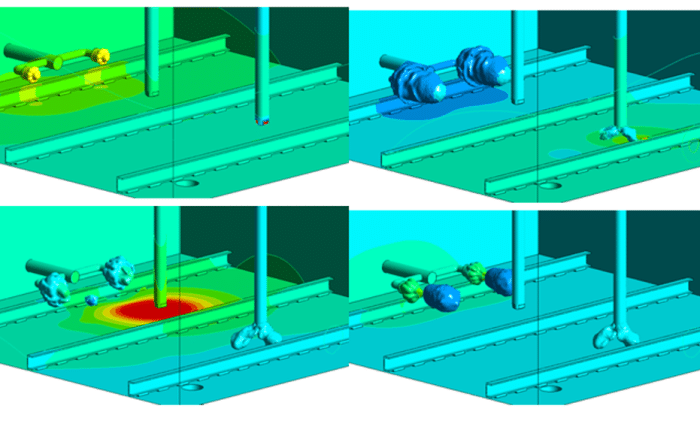
The CFD analysis revealed that the injected steam plume developed through a series of distinct transient stages:
-
Growth
-
Necking
-
Detachment
-
Collapse
These cyclical plume dynamics generated significant transient pressure waves within the vessel.
The colour contours in the CFD model highlighted the pressure fluctuations associated with the collapse phase of the steam plume. These pressure waves were transferred directly to the tank walls, resulting in structural stress and vibration.
This behaviour is characteristic of unsteady steam condensation shock loading, a phenomenon capable of producing cyclic forces that excite structural vibration modes.
The CFD modelling provided clear visualisation and quantification of:
-
Pressure transients
- Localised condensation events
-
Dynamic load generation mechanisms
-
Frequency content of excitation forces
Computational Fluid Dynamics (CFD) Model Showing Steam Plume Growth, Necking, Detachment, and Collapse (Clockwise from Top Left)
2. Structural Integrity Assessment: FEA & Fluid Structure Interaction (FSI)
The transient pressure data from the CFD simulation was coupled with a structural FEA model using a Fluid Structure Interaction (FSI) approach.
This allowed SEAM to simulate the tank’s vibrational response under realistic operating loads and evaluate:
-
Dynamic stress distribution
-
Fatigue life under cyclic loading
-
Fracture risk
-
Structural safety factors
-
Remaining lifetime assessment
By integrating CFD and FEA, SEAM provided a complete understanding of both fluid-driven excitation and structural response behaviour.
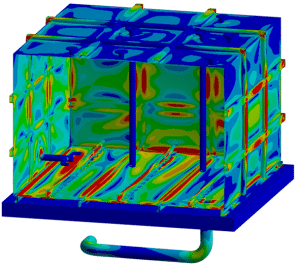
Structural Analysis of Tank
Results & Client Outcomes
The investigation delivered both technical clarity and strategic value as demonstrated in the video below .
Key outcomes included:
-
Definitive identification of unsteady steam condensation as the root cause of tank vibration
-
Quantified assessment of structural integrity margins
-
Evaluation of fatigue and fracture risk under operational conditions
-
Evidence-based recommendations for process mitigation
-
Targeted structural modification strategy with defined implementation timeline
Rather than adopting costly blanket reinforcement or conservative shutdown measures, the client was able to implement risk-based engineering decisions supported by high-fidelity simulation data.
About the Author
Patrick Donnellan is a chartered engineer and a member of the Institution of Mechanical Engineers. He has extensive experience in Computational Fluid Dynamics (CFD), and Finite Element Analysis (FEA) for structural integrity assessments. Within SEAM, Patrick focusses on providing solutions to clients across a wide variety of industries through the use of CFD and Finite Element Analysis (FEA), including include medical device, pharmaceutical, manufacturing, civil and environmental engineering, and HVAC.
Contact Patrick at Patrick.Donnellan@setu.ie for further information about SEAM’s CFD and FEA capabilities .
Surface Texturing on 316L Press-fit Joints Fabricated by Selective Laser Melting
In this study, selective laser melting (SLM) was investigated for the manufacturing of 316L stainless steel press-fit joints. The accuracy of selective laser melting technique in fabrication of texture profile in shape, pitch and height of micro-surface texturing was examined. The resulting insertion and removal forces achieved from the produced textured pins for cold-formed high-end fixation applications were studied. The experimental results showed that the shape, pitch and height of the texture, as well as the resultant bonding strength of the joints, can be effectively set via control of the SLM processing parameters. While trapezoidal and triangular shapes of the texture lead to stronger bonding compared with oval-shaped texture profiles, the texture height was found to have a predominant effect on bond strength. To a much lower extent, larger pitch distances also resulted in higher bond strengths. A combination of abrasive and adhesive wear mechanisms was detected via examination of the inner surface of the hub into which the press fit was inserted. Along with a process map of design of the micro-surface texture geometry of metal interference fit joints, this paper also presents the underlying mechanics for their bonding. The SLM process is shown to present a useful one-step method for the manufacturing of knurl metallic interference fit pins of customisable and definable texture and ensuing bond strength.