 051 845648
 info@seam.ie

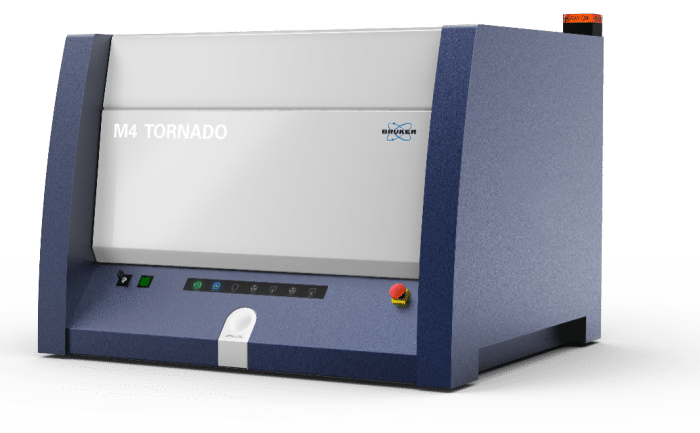
The M4 TORNADO is the tool of choice for sample characterization using small-spot micro X-ray fluorescence. Its measurements give information about composition and element distribution, even from below the surface. Bruker’s micro-XRF spectrometer is optimized for high-speed analyses of points, lines and 2D area scans (element mapping) of any kind of sample; be it organic, inorganic or liquid.
The primary X-ray excitation uses a polycapillary lens offering small spot sizes and high X-ray intensity. The M4 TORNADO is configurable with a variety of Bruker XFlash® silicon drift detectors (SDD), offering high throughput without compromising energy resolution.
As X-rays may pass through matter, XRF in general allows for the determination of layer thicknesses. Using micro-XRF the layer analysis (thickness and composition) is rendered feasible with spatial resolutions on the micrometer scale. Layer analysis is strongly based on atomic fundamental parameter quantification and can be improved by use of standard samples. Thus “common” layer systems, such as ENEPIG coatings, ZnNi coatings, or solder layers, where standards are readily available can be measured with high accuracy but also novel layer systems in an R&D environment can be tested.
Instrument control with tube and acquisition time settings
Monitoring of instrument stability and drift correction
Support of correct sample positioning by camera system,
including auto focus
Mouse, foot switch and touch screen operation
Spectra acquisition, display and processing
Spectra evaluation with peak fit and intensity calculation
Standard-based or standard-supported quantification of
bulk and layer samples
Report generation and data archiving
Please contact us at SEAM to learn how we can help you with any non destructive layer analysis requirements