Thermal Analysis Solutions

Understanding how materials respond to heat, temperature changes and environmental conditions is critical for product performance, quality assurance and material selection. SEAM provides advanced thermal analysis services to help manufacturers, researchers and product developers evaluate material behaviour, stability and long-term performance.

  • 5000+ Projects Delivered

How SEAM Can Help

Thermal analysis provides valuable insights into how materials behave under different temperature conditions. Whether you are developing a new product, validating material performance, investigating failures or assessing material degradation, SEAM's advanced thermal analysis capabilities can help you make informed decisions.

Our team supports companies across medical devices, pharmaceuticals, polymers, electronics, engineering and advanced manufacturing sectors through independent testing and technical expertise.

Key Benefits

  • Advanced thermal characterisation capabilities
  • Independent testing and reporting
  • Support for product validation and quality assurance
  • Material selection and performance evaluation
  • Failure investigation and root cause analysis
  • Fast technical support from experienced researchers
Analysis

Failure Analysis

Identify degradation mechanisms, thermal damage and material performance issues.

Analysis

Product Validation

Verify materials perform as expected under operating conditions.

Analysis

Quality Assurance

Confirm material consistency and thermal stability between production batches.

Analysis

R&D Support

Support new material development and product innovation.

Equipment & Capabilities

SEAM offers a range of advanced thermal analysis technologies including:

Testimonials

Differential Scanning Calorimetry (DSC)

Measures melting points, crystallisation behaviour, glass transition temperatures and thermal properties.

  • Advanced equipment
  • Fast technical support
  • Independent expertise
  • Clear reporting

Thermogravimetric Analysis (TGA)

Evaluates material stability, decomposition behaviour and composition through controlled heating.

  • Advanced equipment
  • Fast technical support
  • Independent expertise
  • Clear reporting
Testimonials
Testimonials

How it Works

  • 1. Submit Enquiry
  • 2. Technical Review
  • 3. Testing / Simulation
  • 4. Report Delivered

Have a project you’d like to discuss?

Submit an Enquiry

Speak directly with SEAM’s experienced industry specialists to discuss your project. Every enquiry is reviewed by highly qualified engineers and technical experts who will recommend the most appropriate testing or analysis approach based on your requirements.

Whether you need independent validation, product development support, quality assurance or failure investigation, we’re here to help. Following completion of the work, you’ll receive a comprehensive technical report outlining the methodology, findings and recommendations, giving you the confidence to make informed engineering and business decisions.

Complete the enquiry form today and a member of our team will be in touch to discuss your requirements and the next steps.

    Case Studies

    Lorem Ipsum is simply dummy text of the printing and typesetting industry. Lorem Ipsum has been the industry's standard dummy text ever since the 1500s, when an unknown

    Projects
    2000 +
    Capabilities
    0 +

    Trusted by Industry

    Frequently Asked Questions

    Find answers to common questions about thermal analysis, material characterisation and testing services. Learn how SEAM helps industry evaluate material performance, stability and long-term durability.

    What is thermal analysis?

    Thermal analysis is a group of testing techniques used to measure how materials respond to changes in temperature. It provides valuable information about material performance, stability and composition

    Thermal analysis can be performed on polymers, composites, pharmaceuticals, coatings, adhesives, ceramics and many other material types.

    Differential Scanning Calorimetry (DSC) measures thermal transitions such as melting points, crystallisation temperatures and glass transition temperatures.

    Thermogravimetric Analysis (TGA) measures weight changes in materials as they are heated, helping identify degradation behaviour, composition and thermal stability.

    Thermal analysis helps engineers and product developers select suitable materials, optimise manufacturing processes and verify product performance under real-world conditions.

    Our Equipment

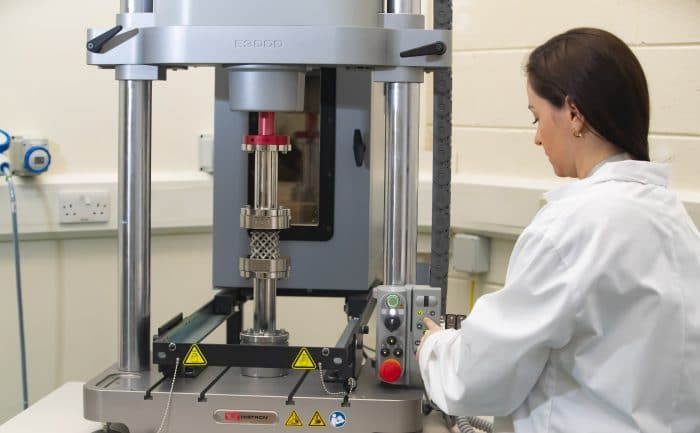
    Instron Electroplus3000

    The ElectroPuls™ E3000 Linear-Torsion is a state-of-the-art, all-electric test instrument engineered for precise dynamic and static tes...